
Key Takeaways
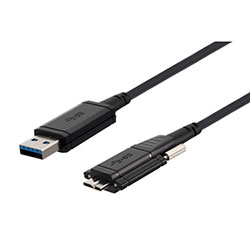
- A USB active optical cable (AOC) converts electrical USB signals to light at one end and back again at the other, carrying data over optical fiber in between.
- USB 3.0 AOCs plug into standard USB ports and work with existing USB 3.0 hosts, hubs and devices.
- They reach far beyond copper USB cables, supporting speeds of 2.2 Gbps at over 100 meters and up to 5 Gbps depending on cable length.
- Their thin, lightweight construction, low power consumption and immunity to EMI/RFI suit security cameras, machine control, medical systems and surveillance.
- USB 3.0 AOCs are not backward compatible with older USB standards, so connected devices must support USB 3.0.
USB has long been proven to be a dependable, flexible and simple-to-use interface that is a staple for a multitude of applications. Along the way, USB has adapted to offer a variety of formats to fit today’s technology needs. From power delivery to SuperSpeed USB 3.1 Gen 1 and Gen 2, USB has got you covered. Now the interface is taking things to another level with the introduction of USB 3.0 active optical cables (AOC). Here’s how they work and when they make sense.
How USB Active Optical Cables Work
Active optical cable technology uses the same electrical inputs as traditional copper cabling, but with optical fiber between connectors. With electrical-to-optical conversion on the cable ends, AOC provides faster speeds and distance performance while also maintaining compatibility with standard electrical interfaces. Building upon the features of AOC, USB 3.0 AOC is made to be compliant with SuperSpeed USB electrical specifications, allowing for easy plug-and-play use and continuous operation between an existing USB 3.0 host, a USB 3.0 powered hub and other USB devices. For a closer look at the technology itself, see an inside and outside look at fiber active optical cables.
Speed, Distance and Applications
These USB cables have an ultra-thin profile and much longer reach than a standard USB cable. In fact, they can reach speeds of 2.2 Gbps at over 100 meters. This allows for USB 3.0 AOC cables to be used in new and different ways USB might not have been able to before, such as with security cameras, industrial and medical machine control systems and in high-def surveillance applications. These cables are capable of speeds up to 5 Gbps, depending on the length of the cable. They also boast low power consumption and minimal EMI/RFI since fiber optic technology is being used.
For long-distance camera and machine vision links over Ethernet instead of USB, see our article on GigE Vision. Before choosing a USB AOC, though, there’s one important limitation to keep in mind.
Compatibility Considerations
Though USB 3.0 AOC is not backwards compatible (it will not support older USB standards), there are many other features that make it worthwhile. Overall, USB 3.0 active optical cables can be a great option if you have an application requiring USB connectivity over a long distance that traditional USB cables cannot meet. What is USB-A? And, if you’re interested, check out the information on this USB A pinout that we have posted.
If your devices need a rugged, weather-resistant connection rather than extreme distance, outdoor USB extension cable assemblies may be a better fit. Still have questions? Here are the ones we hear most often.
FAQs About USB Active Optical Cables
How long can a USB active optical cable be?
USB 3.0 AOCs can run well beyond 100 meters, far longer than passive copper USB 3.0 cables, which are typically limited to a few meters. Maximum speed depends on cable length, with shorter cables supporting up to 5 Gbps.
Do USB AOCs work with USB 2.0 devices?
No. USB 3.0 AOCs carry only SuperSpeed USB signals, so the host and connected device must both support USB 3.0. USB 2.0-only devices will not work over them.
Do USB active optical cables carry power?
It depends on the cable. Because optical fiber cannot carry electricity, many USB AOCs deliver limited or no power to the far end, so connected devices may need their own power supply or a powered USB hub. Always check the cable’s specifications.
What is the difference between an active optical cable and a passive USB cable?
A passive USB cable carries electrical signals over copper wires, which limits its length. An active optical cable converts the signal to light and sends it over optical fiber, enabling much longer runs, a thinner and lighter cable and immunity to electromagnetic interference.
Conclusion
To help you with your next high-speed, long distance USB application, check out our active USB 3.0 cables.
We offer you access to our inventory of more than 50,000 off-the-shelf products. Our strong inventory position means quick availability, low or no minimum order quantities and same-day shipping on in-stock product orders placed weekdays before 6 p.m. CT.
Contact us today with any questions you might have on our wide range of products, call us toll-free at 1-866-845-9906, chat with us live, or email us at sales@l-com.com