
Key Takeaways
- A null modem cable is used for direct serial device-to-device communication.
- Null modem cables are commonly associated with RS-232 interfaces.
- The main difference from a straight-through cable is the crossing of transmit and receive signals.
- DB9 and DB25 are common connector formats for legacy serial applications.
- Not all null modem cables use the same pinout.
- Basic cables may use only TX, RX, and signal ground.
- Other applications may require additional hardware flow-control connections.
- Always verify connector type, gender, pinout, and flow-control requirements.
- A null modem adapter can sometimes be used instead of a dedicated cable.
- A cable tester or multimeter can help verify the wiring.
- Never assume that a serial cable is a null modem cable simply because it uses a DB9 connector.
What Is GigE Vision?
As big data has gotten bigger and bigger, so have vision applications. GigE Vision is a global interface standard designed to support the transmission of high-speed video and related control data over Ethernet networks that include GigE, 10 GigE and 802.11 wireless networks.
What makes the standard so practical is how it handles bandwidth, distance and cabling.
GigE Vision Performance and Cabling
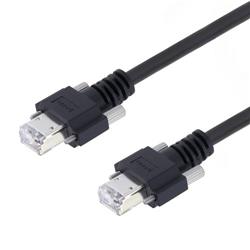
This standard was developed using the Gigabit Ethernet communication protocol and provides fast image transfer using readily available GigE Vision Ethernet cables over extended distances. GigE Vision is capable of fast, high-bandwidth transfers of large images in real time at 125 MB/s and up to 100 meters in length. With the use of standard Cat5e and Cat6 cables and connectors, using GigE Vision is cost effective, highly scalable and allows for simple integration by using existing Ethernet infrastructures. Not sure which category to choose? Our comparison of Cat5e vs. Cat6 vs. Cat6a industrial Ethernet cables breaks down the differences.
Performance is only part of the story, though. GigE Vision’s real strength is that it works across vendors.
Interoperability Across Vendors
Managed by the A3 (the Association for Advancing Automation, formerly the AIA), a trade association for the machine vision industry, the GigE Vision standard was introduced in 2006 and has since been adopted globally, with most major industrial video hardware and software vendors having developed products that are GigE Vision-compliant. By following the same standard, products from different vendors are all interoperable. This means frame grabbers, embedded hardware interfaces, cameras, video servers, video receivers, control applications and management entities can all work together seamlessly using a common Ethernet platform.
That interoperability depends on a shared programming interface called GenICam.
GigE Vision and GenICam
Much like USB3 Vision, GigE Vision relies on GenICam, a generic programming interface for different types of cameras, to access and control features in cameras and other imaging devices that are compliant. The simplicity of installation and high-performance specs of GigE Vision makes it ideal for industrial applications. The standard is also used in telecom, military, data communications and machine vision applications. For more on the cabling behind these systems, see our complete guide to industrial Ethernet cables.
To keep pace with these demanding applications, the standard has continued to evolve.
GigE Vision Versions and What’s New in 3.0
GigE Vision has evolved steadily since its launch. Version 2.0 added faster streaming over 10 Gig Ethernet and link aggregation, along with the Precision Time Protocol (PTP) that enables cameras to be activated at the same time and Trigger-over-Ethernet without the need for an I/O cable. These features make it ideal for multi-camera systems, which can be precisely synchronized, transmit compressed images and benefit from enhanced support for multi-tap sensors. Later 2.x versions added GenDC streaming, multi-event data and non-streaming device control.
Most recently, in May 2026, A3 released GigE Vision 3.0, which adds support for RoCEv2 (RDMA over Converged Ethernet). This lets cameras transfer image data directly into a computer’s memory, reducing CPU load and latency and enabling bandwidths of 400G and beyond, while keeping the interoperability GigE Vision is known for. With all its capabilities and benefits, GigE Vision has proven to be a boon in the world of vision applications.
Still have questions? Here are the ones we hear most often.
FAQs About GigE Vision
Q1: What is the difference between GigE Vision and USB3 Vision?
A: Both standards use GenICam to control cameras. GigE Vision runs over Ethernet, supports cable runs of up to 100 meters and makes it easy to network many cameras. USB3 Vision connects cameras directly to a host computer and offers more bandwidth than standard Gigabit Ethernet, but over much shorter cable lengths.
Q2: What cables does GigE Vision use?
A: GigE Vision uses standard Ethernet cabling, typically Cat5e or Cat6 with RJ45 connectors. For industrial installations, GigE Vision cables often feature screw-locking connectors to prevent disconnection from vibration, and high-flex jackets for cameras mounted on moving equipment.
Q3: What is the maximum cable length for GigE Vision?
A: GigE Vision supports copper cable runs of up to 100 meters between devices. Longer distances can be achieved using network switches or fiber optic links.
Q4: Does GigE Vision support Power over Ethernet?
A: Many GigE Vision cameras support Power over Ethernet (PoE), which delivers power and data over a single cable. This simplifies installation and reduces cabling, especially in multi-camera systems.
Conclusion
From a single camera to large, synchronized multi-camera systems, GigE Vision offers a cost-effective, interoperable way to move high-speed image data over standard Ethernet. L-com offers a wide selection of GigE Vision Ethernet cables, with same-day shipping on all qualified, in-stock, online orders received Monday through Friday before 5 p.m. EST.