
- Home /
- Resources /
- Frequently Asked Questions /
- What is the Difference between Stranded and Solid Conductors?
What is the Difference between Stranded and Solid Conductors?
No matter if your cable is Cat3, Cat5, Cat5e, Cat6, Cat6a or Cat7 rated, it is also classified as either "solid" or "stranded".
A solid cable is most commonly used as a backbone cable in walls,ceilings and conduit, where flexibility isn't really needed. This is because a solid cable's conductors are made of solid metal (usually a single thick copper wire) and the cable as a whole is generally more rigid. Additional characteristics:
- Transmits electrical signals better over longer distances
- Lower attenuation (resistance)
- More likely to break with repetitive bending
- Lower Cost
- Used for horizontal cabling in Ethernet networks
In a stranded cable, the conductors are made up of many fine metal filaments which are twisted together to form a larger, thicker wire. Due to this composition of thin wires, the stranded cables are a lot more flexible than solid cable. Stranded cables are commonly used as patch cords and other shorter network cables that require frequent flexing and bending during use. Additional characteristics:
- Shorter transmission distance (de-rate length by 25-50%)
- Higher Attenuation (resistance)
- Not likely to break due to repetitive bending (continuous movement cables require special jackets)
- Higher Cost
- Used for patch cabling in Ethernet networks
Contact Design - RJ45 plugs
There are multiple designs for contacts on RJ45 plugs, which are used for specific reasons. Not all plugs work on all cables. Often users just pick one plug and use it for everything, but this can result in a less reliable termination. For either a solid or stranded cable, keep these options in mind:
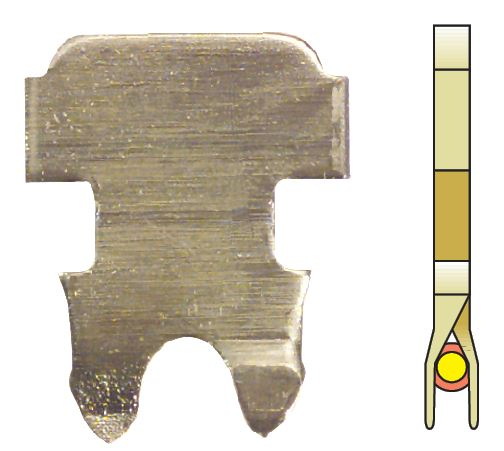
Two point staggered - Stranded or Solid: The contact prongs straddle the conductor.
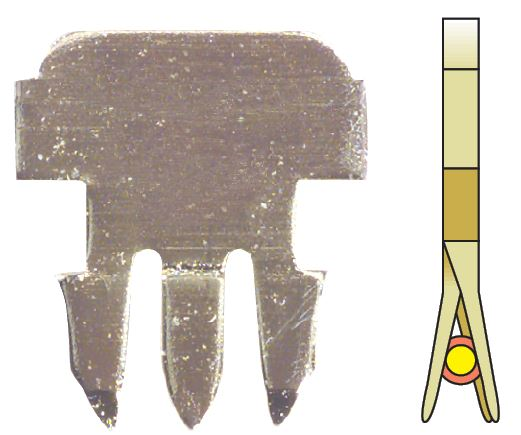
Tripoint type - Stranded or Solid: Long contact prongs spread apart to accept the conductor.
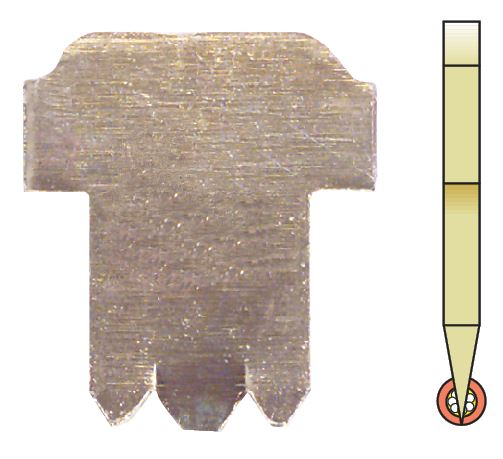
Piercing type - Stranded Only: Jagged end pierces jacket and embeds into the strands of the conductor.
Resources
- Application Overviews
- Blog: Engineering Hub
- Case Studies
- Credit Application
- Connector Charts
- Custom Cable Configurators
- Featured Products
-
Frequently Asked Questions
- How do I change my password?
- What is the difference between simplex and duplex fiber optic cable?
- How do I update my personal and company details?
- How do I add or edit my address information?
- How do I view my order history?
- How do I reorder?
- How can I change my communication preferences?
- How do I sign up for your newsletter?
- What does RG316/U mean?
- What is a Distributed Antenna System (DAS)?
- What is plenum rated cable, and why is plenum cable more expensive than PVC cable?
- What is the difference between male and female connectors?
- What is the difference between 75 Ohm and 50 Ohm coaxial cable and when should each one be used?
- What is the difference between VGA, SVGA and UXGA, and does L-com sell cables for each?
- What are some popular Fiber Optic connector types?
- What do the fiber terms 9/125, 50/125 and 62.5/125 refer to?
- Why Use Shielded Cat 6 Cable vs. Unshielded Cat 6 cable?
- Is your website secure?
- How do I return a purchase?
- What are your shipping and processing fees?
- What is the difference between VGA, SVGA and UXGA?
- What are common WiFi Antenna FAQs?
- How do I check my order status?
- What does IP67 mean? I need waterproof cables, connectors, and adapters
- How do I request your product guide?
- What is your Privacy Policy?
- How can I follow L-com on social media?
- What are your Terms and Conditions?
- What is your contact information?
- What is Coaxial Cable?
- What is a USB Cable?
- What is a DB9 Connector?
- Can Too Much Gain Be A Bad Thing?
- What is the Difference between Stranded and Solid Conductors?
- What are the Advantages and Disadvantages of ISM Band Frequencies?
- Industry Application Brochures
- Industrial Solutions
- Product Brochures
- Product Guide Downloads
- Technical Briefs and Articles
- White Papers
- Wireless Calculators