
- Home /
- Resources /
- Frequently Asked Questions /
- Can Too Much Gain Be A Bad Thing?
Can Too Much Gain Be A Bad Thing?
WiFi Network Design: When Too Much Gain Is a Bad Thing
When designing a wireless network people often times choose a higher gain WiFi antenna thinking this will give them the strongest signal and highest quality WiFi connection. This is true in some cases but in some WiFi applications too much gain is a bad thing.
For example say you want to set up a wireless network in an outdoor courtyard area for a café. For this application you would use an Omni directional antenna to provide 360° wireless coverage to your customers. In the diagram below you can see the centrally located Omni antenna is rated at 15 dBi.
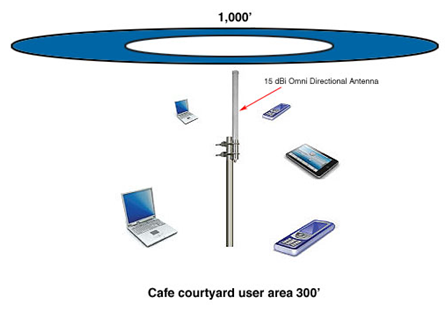
This high gain will project the WiFi signal well beyond the required 300 foot coverage area and actually give better signal quality to people far outside the courtyard. Users within the 300 foot area will actually see lower speeds and poorer signal quality as a high gain antenna is being used. For this application a lower gain antenna such as a 5 or 8 dBi antenna would actually provide better signal quality and coverage to the café' users (see diagram below).
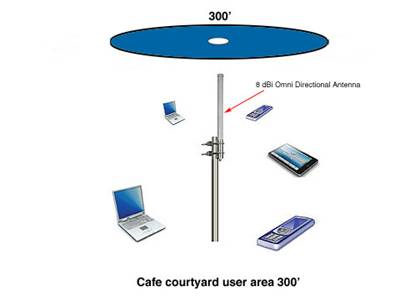
Also a high gain antenna will not reach users closer to the ground say in a chair as the wireless signal is "stretched" and provides better horizontal coverage than vertical coverage. Conversely the lower dBi antenna provides more of a "donut" shaped signal pattern projecting the WiFi signal lower to the ground with better vertical reach. So depending on your wireless application, a high gain antenna might not be the answer.
L-com offer thousands of off the shelf as well as custom WiFi Antennas with many gain options to address your specific application requirements.
Resources
- Application Overviews
- Blog: Engineering Hub
- Case Studies
- Credit Application
- Connector Charts
- Custom Cable Configurators
- Featured Products
-
Frequently Asked Questions
- How do I change my password?
- What is the difference between simplex and duplex fiber optic cable?
- How do I update my personal and company details?
- How do I add or edit my address information?
- How do I view my order history?
- How do I reorder?
- How can I change my communication preferences?
- How do I sign up for your newsletter?
- What does RG316/U mean?
- What is a Distributed Antenna System (DAS)?
- What is plenum rated cable, and why is plenum cable more expensive than PVC cable?
- What is the difference between male and female connectors?
- What is the difference between 75 Ohm and 50 Ohm coaxial cable and when should each one be used?
- What is the difference between VGA, SVGA and UXGA, and does L-com sell cables for each?
- What are some popular Fiber Optic connector types?
- What do the fiber terms 9/125, 50/125 and 62.5/125 refer to?
- Why Use Shielded Cat 6 Cable vs. Unshielded Cat 6 cable?
- Is your website secure?
- How do I return a purchase?
- What are your shipping and processing fees?
- What is the difference between VGA, SVGA and UXGA?
- What are common WiFi Antenna FAQs?
- How do I check my order status?
- What does IP67 mean? I need waterproof cables, connectors, and adapters
- How do I request your product guide?
- What is your Privacy Policy?
- How can I follow L-com on social media?
- What are your Terms and Conditions?
- What is your contact information?
- What is Coaxial Cable?
- What is a USB Cable?
- What is a DB9 Connector?
- Can Too Much Gain Be A Bad Thing?
- What is the Difference between Stranded and Solid Conductors?
- What are the Advantages and Disadvantages of ISM Band Frequencies?
- Industry Application Brochures
- Industrial Solutions
- Product Brochures
- Product Guide Downloads
- Technical Briefs and Articles
- White Papers
- Wireless Calculators