
By Dustin Guttadauro, Product Line Manager - Telecom & Fiber, Infinite Electronics
Antenna masts used in tactical UAV operations are inherently exposed to environmental risk, particularly lightning. Elevated structures combined with conductive RF cabling create a direct path for high-energy transients to reach ground control station (GCS) equipment.
In field deployments, where grounding infrastructure is often improvised, this risk is amplified. Lightning events—whether direct strikes or induced surges—can introduce thousands of amps into the system in microseconds, overwhelming unprotected electronics.
Effective lightning protection requires more than simply grounding the mast. It demands a coordinated approach that includes surge protection, low-impedance grounding paths and properly integrated RF hardware.
Key Takeaways
- Lightning-induced surges can enter GCS systems through antenna feedlines
- Surge protectors rated for high current events provide critical system protection
- Wideband antennas must be paired with properly integrated protection hardware
- Ground path impedance directly impacts surge dissipation effectiveness
- Environmental sealing is essential to maintain performance in wet conditions
Assessing the Risk: The Physics of the Strike
Lightning events impact RF systems in two primary ways: direct strikes and induced surges.
A direct strike delivers massive current directly into the structure. Induced surges occur when nearby lightning creates electromagnetic fields that couple energy into conductive elements such as coaxial cables.
Even without a direct hit, induced energy can travel along the feedline and into the GCS. Because RF cables provide a low-resistance path, they often become the preferred route for this energy.
The concept of a “cone of protection” is often used to estimate the area shielded by a grounded mast, but in practice, cable protection remains essential regardless of mast geometry.
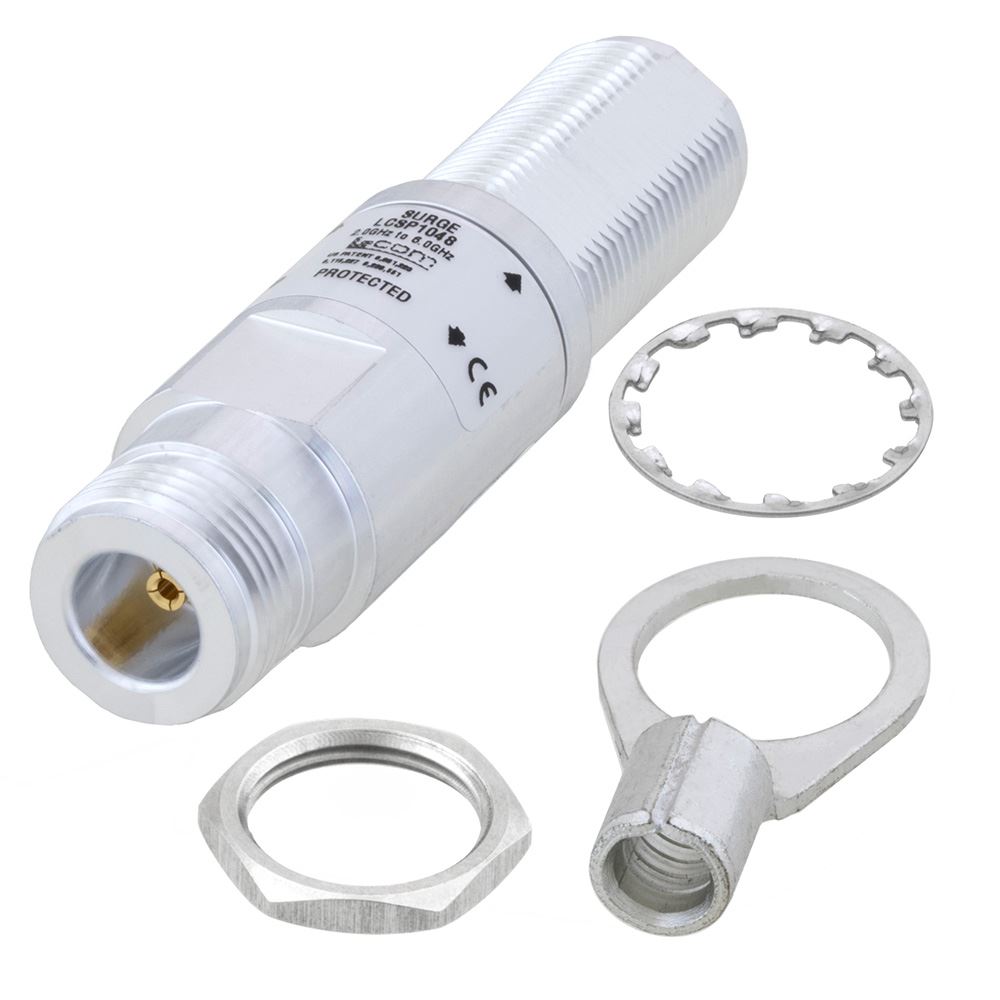
High-Capacity Defense: LCSP1048 Surge Protector
The LCSP1048 provides inline surge protection for RF systems using gas discharge tube (GDT) technology.
When a high-voltage transient occurs, the GDT rapidly ionizes, creating a low-resistance path to ground. This diverts the surge away from downstream equipment before it can cause damage.
The LCSP1048 is designed to handle high-current events, including multiple surges in the 10 kA range. Unlike consumer-grade devices, it is built for repeated exposure without requiring replacement after a single event.
During normal operation, the device introduces minimal insertion loss, ensuring that RF performance remains unaffected.
Tactical Wide-Band Coverage: HG72703RDR-SM Antenna
Wideband antennas such as the HG72703RDR-SM support multiple communication links across 698 MHz to 2700 MHz, including C2, LTE and public safety bands.
This flexibility makes them well-suited for tactical GCS deployments where multiple systems must operate simultaneously.
From a mechanical standpoint, ruggedized construction is critical. Spring bases and reinforced radomes allow the antenna to withstand wind loading and environmental stress associated with storm conditions.
Integrating surge protection directly below the antenna ensures that all connected systems benefit from a unified protection strategy.
How do you design a zero-failure GCS grounding system?
A reliable grounding system depends on minimizing impedance across the entire discharge path.
Single-point grounding (SPG) ensures that the antenna mast, surge protector and GCS chassis share a common reference. This prevents potential differences that can lead to arcing between components.
The connection from the LCSP1048 to the ground rod must be as short and straight as possible. Sharp bends and long runs increase inductive reactance, reducing the effectiveness of surge dissipation.
Ground rod installation is equally important. Copper-clad rods should be driven into conductive soil, and multiple rods may be required in dry or rocky environments to achieve acceptable resistance.
Deployment Checklist for Field Engineers
Proper deployment and maintenance ensure continued protection in operational environments.
Visual inspection after storms can reveal damage such as pitting or carbon scoring on surge protectors, indicating that a transient event has occurred.
Continuity testing verifies that the grounding path remains intact. A low-resistance connection—typically below 5 ohms—indicates an effective ground.
Routine checks help ensure that protection systems remain functional throughout the mission lifecycle.
L-com’s broad selection of RF surge protection and antenna solutions supports safe and reliable UAV ground station deployment. For minimal downtime and rapid deployment, we ship quickly, with same-day shipping on qualified in-stock online orders placed Monday through Friday before 5 p.m. EST.
Frequently Asked Questions (FAQ)
Is grounding the antenna mast alone sufficient for lightning protection?
No. While grounding the mast helps dissipate some energy, the coaxial feedline provides a lower-resistance path for transient currents. Without an inline surge protector such as the LCSP1048, surge energy can travel directly into connected equipment.
Will adding a surge protector impact RF performance or range?
High-quality surge protectors introduce minimal insertion loss, typically less than 0.1 dB. This has negligible impact on system performance while providing critical protection against high-energy transients.
How should a vehicle-mounted GCS be grounded in the field?
The vehicle chassis provides an initial ground reference, but additional grounding—such as a deployed rod or grounding strap—improves safety during stationary operation. Surge protection should be installed at the cable entry point to prevent energy from entering the cabin.
Can a wideband antenna support multiple UAV communication links simultaneously?
Yes. Antennas such as the HG72703RDR-SM are designed to operate across multiple frequency bands, enabling support for C2, LTE and other communication systems within a single platform, provided proper filtering and system design are implemented.