
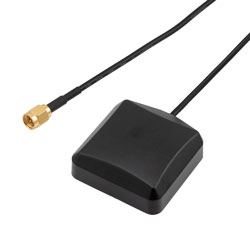
Not sure if you need a GPS antenna? Wondering the best way to use a GPS antenna? These specialized antennas are made to receive and amplify radio signals which are transmitted on specific frequencies by GPS satellites. Those signals are then converted to an electronic signal to be used by a GPS receiver. And so, the output of the GPS antenna is fed into the receiver which can calculate the position. Here, we will take a closer look at GPS antennas, their uses, and applications.
Key Takeaways
-
GPS/GNSS antennas are critical components in any satellite-navigation system: they receive weak satellite signals and must be properly matched in design, polarization, and placement
-
Choosing the right antenna involves matching frequency band(s) (e.g., 1575 MHz L1, plus possibly L2/L5), connector type, impedance (typically 50 Ω), and ensuring a clear view of the sky for maximum performance.
-
Different types of antennas (patch, helical, active vs passive) offer trade-offs in size, gain, mounting style and environmental ruggedness, so application context (vehicle, marine, industrial, indoors) matters a lot.
-
Proper mounting, grounding, and cable consideration (loss, shielding) affect accuracy, time-to-first fix (TTFF) and reliability—neglecting these can degrade performance even with a high-quality antenna.
-
For external/harsh environments, look for ruggedization such as weatherproofing (IP67), durable randoms, right-hand circular polarization (RHCP), and good connector/cable integration.
First, let’s get a better idea of reasons why you might need a GPS antenna. For example, in a vehicle, if a GPS receiver will not be near a window, a GPS antenna might be necessary to ensure you don’t lose signal. Also, in canyons, when surrounded by tall buildings, under cover of a lot of trees or any time view of the sky is obstructed, an external GPS antenna can be a huge help. They can also help avoid loss of signal in a moving vehicles and aid in generally maintaining the best satellite signal.
There are three different types of GPS antennas:
Active GPS antennas include a Low Noise Amplifier (LNA) to compensate for signal loss that happens with all cables. Power from the GPS receiver is required and provided by an external antenna jack in order to power the LNA which, in turn, can drain the receiver’s batteries faster.
Passive GPS antennas don’t include LNAs and thus don’t require power. However, because they’re not powered, one meter is usually the maximum cable length for the pigtail.
Reradiating GPS antennas are made up of two separate antennas. The transmitting, reradiating, antenna is near the GPS receiver while the receiving antenna is outside the building or vehicle. The two antennas are connected by a coaxial cable and powered by either an AC adapter or a 12-volt vehicle supply. This type of GPS antenna is necessary if there isn’t an external antenna jack on your GPS system.
Applications that are ideal for GPS antennas include ground mapping, survey, construction, agriculture, mining, and permanent and temporary reference stations. Of course, GPS antennas are an immense asset for aircraft. And with today’s developments in transportation technology, GPS antennas are a must for unmanned vehicles.
Recommendations
-
Evaluate your application scenario (vehicle, marine, embedded device, outdoor fixed mount) and select an antenna suited to its environmental, mounting and RF conditions.
-
Match the antenna frequency/band support with your GNSS receiver (e.g., GPS L1, GLONASS, Galileo) and ensure the antenna covers those bands.
-
Choose antennas with integrated low-noise amplifiers (LNAs) for low-signal-strength environments (urban canyon, indoors, under foliage).
-
Choose durable antennas with appropriate IP/ingress ratings, UV/chemical resistance for outdoor use, and ensure proper cable/connector selection to maintain signal integrity.
-
Ensure the antenna mounting location offers clear sky view, minimal multipath (reflections) and is mechanically stable (for mobile or vibration-prone installations).
-
Document and test the antenna installation—verify signal strength, satellite count, fix times which helps validate that the antenna is performing as required.
Now that you know the ins and outs of GPS antennas, be sure to check out our high-performance GPS antennas including GPS cellular WiFi antennas and antenna connectors that are in-stock and available for immediate delivery.
We offer you access to our inventory of more than 50,000 off-the-shelf products. Our strong inventory position means quick availability, low or no minimum order quantities and same-day shipping on in-stock product orders placed weekdays before 6 p.m. CT.
Contact us today with any questions you might have on our wide range of products, call us toll-free at 1-800-341-5266, chat with us live, or email us at sales@l-com.com.
