
- Home /
- Resources /
- Frequently Asked Questions /
- What is a Distributed Antenna System (DAS)?
What is a Distributed Antenna System (DAS)?
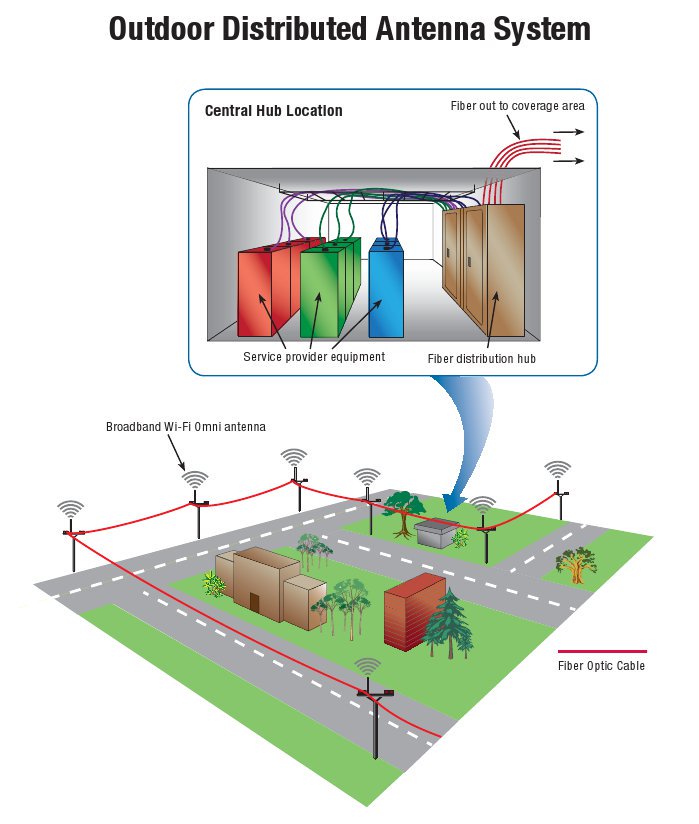
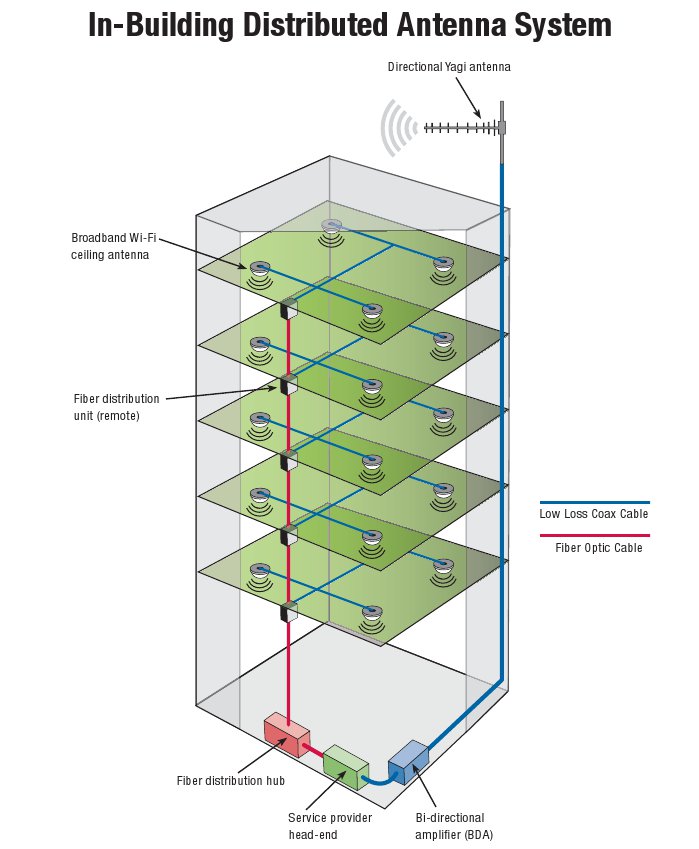
A Distributed Antenna System (DAS) involves the use of several antennas as opposed to one antenna to provide wireless coverage to the same area but with reduced total power and additional reliability. Often times a DAS uses RF directional couplers and/or wireless amplifiers to split and amplify the wireless signal from the source out to the distributed antennas. In many cases a DAS will use a combination of low loss coaxial cabling as well as fiber optic cabling supporting radio over fiber (RoF) technology to distribute the wireless signals to the antennas. A Distributed Antenna System can be designed for use indoors or outdoors and can be used to provide wireless coverage to hotels, subways, airports, hospitals, businesses, roadway tunnels etc. The wireless services typically provided by a DAS include PCS, cellular, Wi-Fi, police, fire, and emergency services.
Resources
- Application Overviews
- Blog: Engineering Hub
- Case Studies
- Credit Application
- Connector Charts
- Custom Cable Configurators
- Featured Products
-
Frequently Asked Questions
- How do I change my password?
- What is the difference between simplex and duplex fiber optic cable?
- How do I update my personal and company details?
- How do I add or edit my address information?
- How do I view my order history?
- How do I reorder?
- How can I change my communication preferences?
- How do I sign up for your newsletter?
- What does RG316/U mean?
- What is a Distributed Antenna System (DAS)?
- What is plenum rated cable, and why is plenum cable more expensive than PVC cable?
- What is the difference between male and female connectors?
- What is the difference between 75 Ohm and 50 Ohm coaxial cable and when should each one be used?
- What is the difference between VGA, SVGA and UXGA, and does L-com sell cables for each?
- What are some popular Fiber Optic connector types?
- What do the fiber terms 9/125, 50/125 and 62.5/125 refer to?
- Why Use Shielded Cat 6 Cable vs. Unshielded Cat 6 cable?
- Is your website secure?
- How do I return a purchase?
- What are your shipping and processing fees?
- What is the difference between VGA, SVGA and UXGA?
- What are common WiFi Antenna FAQs?
- How do I check my order status?
- What does IP67 mean? I need waterproof cables, connectors, and adapters
- How do I request your product guide?
- What is your Privacy Policy?
- How can I follow L-com on social media?
- What are your Terms and Conditions?
- What is your contact information?
- What is Coaxial Cable?
- What is a USB Cable?
- What is a DB9 Connector?
- Can Too Much Gain Be A Bad Thing?
- What is the Difference between Stranded and Solid Conductors?
- What are the Advantages and Disadvantages of ISM Band Frequencies?
- Industry Application Brochures
- Industrial Solutions
- Product Brochures
- Product Guide Downloads
- Technical Briefs and Articles
- White Papers
- Wireless Calculators