
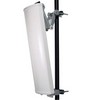

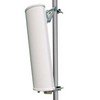
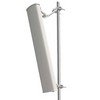
Antennas 2.4 GHz WiFi Antennas - 2.4 GHz Sectorial Antennas
2.4 GHz sectorial antennas deliver directional wireless coverage for WLAN, WiFi, and Wireless Internet Service Provider (WISP) deployments operating within the 2.4 GHz ISM band supporting IEEE 802.11b/g/n standards. Available in 90°, 120°, and 180° beamwidth options with gain levels from 12 dBi to 20 dBi enabling network designers to segment coverage areas for point-to-multipoint and cell-site applications. Featuring single-band and multi-band designs with standard, dual-polarized, and X-Pol spatial diversity configurations supporting MIMO systems. UV-resistant radome construction for outdoor installations.
For comprehensive 2.4 GHz wireless antenna solutions beyond sectorial designs, explore our 2.4 GHz Wi-Fi Antennas - Parabolic, Patch, Omni, Ceiling, Panel, Log Periodic, Yagi, Sectorial, Rubber Duck, Mobile, Marine category, featuring omnidirectional and directional antenna types designed for WLAN, WiFi, WISP, and wireless infrastructure applications across indoor and outdoor deployments.
Related Categories:
- 2.4 GHz Patch Antennas
- 2.4 GHz Omni Antennas
- 2.4 GHz Log Periodic Antennas
- 2.4 GHz Rubber Duck Antennas
- 2.4 GHz Marine Antennas
FAQs
What are 2.4 GHz sectorial antennas used for?
L-com 2.4 GHz sectorial antennas are designed for directional wireless coverage in WLAN, WiFi, and Wireless Internet Service Provider (WISP) deployments. These sector antennas operate within the 2.4 GHz ISM band and support IEEE 802.11b, 802.11g, and 802.11n standards. This category is commonly used for public wireless hotspots, campus WiFi networks, wireless video systems, and WISP cell sites where directional coverage segments coverage areas.
What beamwidth options are available for 2.4 GHz sectorial antennas?
2.4 GHz sectorial antennas are available with 90°, 120°, and 180° beamwidth options, allowing network designers to segment coverage areas for point-to-multipoint and cell-site applications. Gain levels typically range from approximately 12 dBi to 20 dBi, depending on the model. The different beamwidth options enable coverage optimization based on deployment requirements, with narrower beamwidths providing higher gain and focused coverage while wider beamwidths supporting broader sectorial coverage patterns.
What polarization configurations do 2.4 GHz sector antennas support?
2.4 GHz sector antennas support standard, dual-polarized, and spatial diversity (X-Pol) configurations in both single-band and multi-band designs. They are available with vertical, horizontal, and slant polarization options to accommodate different radio and access point requirements in wireless LAN infrastructure. Select models feature multiple N-Female connectors to support MIMO and polarization diversity systems, while others use a single connector with internal combiners to simplify installation.
How are 2.4 GHz sectorial antennas mounted?
L-com offer mechanical designs that support mast-mount installations with adjustable down-tilt brackets, enabling coverage optimization for 2.4 GHz sectorial antennas based on terrain and deployment height. The mounting hardware accommodates various pole diameters and allows antenna positioning adjustment for optimal coverage in WLAN, WiFi, and WISP deployments. Adjustable down-tilt capability supports coverage shaping for cell-site applications and point-to-multipoint installations requiring vertical coverage angle optimization.
What construction materials are used in 2.4 GHz sector antennas?
2.4 GHz sector antennas use UV-resistant radome materials such as PVC, polymer, fiberglass, or plastic to support reliable outdoor operation across a wide temperature range. These construction materials make the antennas suitable for permanent outdoor installations where wind loading and environmental exposure must be considered. The UV-resistant radome protects internal antenna elements in campus WiFi networks, WISP cell sites, and public wireless hotspot deployments experiencing continuous outdoor conditions.
What applications benefit from 2.4 GHz sectorial antennas?
2.4 GHz sectorial antennas are commonly used for public wireless hotspots, campus WiFi networks, wireless video systems, and WISP cell sites. Their directional radiation patterns help manage interference and support improved frequency reuse in dense wireless deployments. Sectorial antennas segment coverage areas for point-to-multipoint applications, enabling multiple sectors to cover 360-degree areas while supporting MIMO and polarization diversity systems.
Need assistance selecting the right 2.4 GHz sectorial antenna for your WLAN, WiFi, or WISP deployment? Our engineering team provides expert technical guidance on beamwidth selection, gain specifications, polarization configurations, MIMO compatibility, and mounting options for your specific wireless coverage requirements.
Contact Sales: Sales@L-com.com
Product Technical Support: techsupportrf@infiniteelectronics.com
L-com offers a wide selection of in-stock 2.4 GHz sectorial antennas to support directional wireless coverage for domestic and international shipping. Whether you are deploying WLAN and WiFi networks, building WISP cell sites, or expanding campus and public wireless coverage, L-com provides dependable sector antenna solutions designed to support controlled coverage and efficient frequency reuse.