
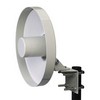

Parabolic Dish Antennas - 2.4 GHz Wi-Fi
Parabolic dish antennas deliver long-range directional wireless communication where focused signal transmission and reception are essential for point-to-point and point-to-multipoint links, wireless backhaul systems, and bridge applications. Operating in the 2.4 GHz band, these antennas concentrate RF energy into narrow beams through parabolic reflector design, supporting extended range and controlled signal paths in outdoor environments requiring precise alignment. Gain levels increase with dish size, enabling system designers to match distance and link budget requirements.
For comprehensive 2.4 GHz wireless antenna solutions, explore our 2.4 GHz Wi-Fi Antennas - Parabolic, Patch, Omni, Ceiling, Panel, Log Periodic, Yagi, Sectorial, Rubber Duck, Mobile, Marine category, featuring directional and omnidirectional antenna types designed for indoor and outdoor wireless LAN, bridge, and RF communication applications.
Related Categories:
- 2.4 GHz Patch Antennas
- 2.4 GHz Omni Antennas
- 2.4 GHz Log Periodic Antennas
- 2.4 GHz Rubber Duck Antennas
- 2.4 GHz Marine Antennas
FAQs
What are 2.4 GHz parabolic dish antennas used for?
Parabolic dish antennas are used for long-range directional wireless communication where focused signal transmission and reception are required. These antennas are commonly deployed in point-to-point and point-to-multipoint links, wireless backhaul systems, and bridge applications. Their parabolic reflector design concentrates RF energy into a narrow beam, making them suitable for installations that require extended range and controlled signal paths in outdoor wireless environments.
How does dish size affect parabolic dish antenna performance?
Gain levels increase with dish size, allowing system designers to select an antenna that aligns with distance and link budget requirements. Larger parabolic reflectors concentrate more RF energy into narrower beams, providing higher gain and extended range for long-distance wireless links. This relationship between dish size and gain enables precise matching of antenna performance to specific point-to-point, wireless backhaul, and bridge application requirements.
Where are 2.4 GHz parabolic dish antennas typically installed?
2.4 GHz parabolic dish antennas are typically used in outdoor environments where precise alignment is required for optimal link performance. Our parabolic antennas are generally mounted on masts or poles using adjustable mounting hardware that allows for tilt and alignment. The reflector construction is intended to support stable performance in outdoor installations where environmental exposure is a factor across point-to-point wireless links and backhaul connections.
What polarization options do parabolic dish antennas support?
Parabolic dish antennas support single or dual polarization configurations, enabling integration with modern wireless and MIMO systems. Polarization flexibility allows system designers to optimize link performance and accommodate dual-polarity equipment in point-to-point and point-to-multipoint deployments. This capability supports both standard single-polarization links and advanced MIMO configurations requiring dual-polarization operation in wireless backhaul and RF communication systems.
What applications use 2.4 GHz parabolic dish antennas?
Common applications include point-to-point wireless links, wireless bridges, backhaul connections, long-range WLAN deployments, and RF communication systems. Parabolic Dish antennas are commonly deployed where focused signal transmission and reception are required over extended distances. Their parabolic reflector design concentrates RF energy into narrow beams, making them suitable for installations requiring controlled signal paths and extended range coverage.
How are parabolic dish antennas mounted for outdoor use?
L-com parabolic dish antennas are generally mounted on masts or poles using adjustable mounting hardware that allows for tilt and alignment. This adjustable mounting enables precise antenna positioning for optimal link performance in point-to-point and point-to-multipoint deployments. The mounting hardware supports installation in outdoor environments where precise alignment is required, accommodating various pole sizes and installation configurations across wireless backhaul and bridge applications.
Need assistance selecting the right 2.4 GHz parabolic dish antenna for your point-to-point link or wireless backhaul installation? Our engineering team provides expert technical guidance on antenna gain selection, dish sizing, polarization configurations, and link budget calculations for your specific application requirements.
Contact Sales: Sales@L-com.com
Product Technical Support: techsupportrf@infiniteelectronics.com