
Specialized Cabling for Military Applications
Download the Full Whitepaper (PDF)Executive Summary
Key Takeaways:
- Unique demands of military/defense environments
- Communications in combat/theatre operations face harsher conditions than commercial systems: temperature extremes, shock/vibration, electromagnetic interference (EMI), chemical exposure, high reliability, & ruggedisation.
- Cabling and interconnects often become the weak link in rugged systems if not designed upfront for these stresses.
- Shielding, materials and construction matter
- Use of shielded twisted-pair cables (STP) or fiber optic when copper isn’t feasible in high EMI environments.
- Jacket and insulation materials must be selected to resist chemicals, UV, abrasion, temperature extremes, and meet military specs.
- Early design & integration is critical
- Waiting until late in design to consider cabling leads to sub-optimal choices, higher cost, and reliability risk.
- The white paper emphasizes engaging cable/interconnect experts early to define requirements (environmental, electrical, mechanical) rather than assuming commercial off-the-shelf will suffice.
- Standards and testing requirements differ
- Military standards (often prefixed “MIL-”, or equivalent defense/aviation specs) apply. These cover performance (e.g., flex life, EMI immunity, pull strength), environmental exposure, durability, and lifecycle.
- Even when an application looks like a “typical” networking or communications installation, the cabling must be evaluated under more stringent conditions.
- Trade-offs: cost vs performance vs risk
- Rugged/military-grade cabling is typically higher cost, but the cost of failure/troubleshooting in theatre is far higher.
- The white paper suggests that the premium is justified when mission-critical reliability is required.
Fiber Optics in Military Communications
Communications systems for use in combat theatre operations require unique considerations compared to nonmilitary, commercial communications systems. Many of the voice, video, and data systems used by the military are mobile and designed for rapid deployment in harsh environments where temperature extremes, shock, vibration, dust, and moisture are prevalent. The constant jostling, vibration, and even major shock experienced in combat could potentially disable a commercial datacom system. Other potential hazards encountered in military operations include heavy EMI and RFI caused by proximity to “noise” generating devices such as motors, switching power supplies, and microprocessors.
When designing a communications network for military applications all the factors listed above must be taken into consideration. Today specialized infrastructure products exist to address the needs of a combat ready military communications system.
Why Fiber Optics?
The use of fiber optic technology in military communications systems provides several benefits, first fiber is immune to EMI and RFI “noise”, secondly fiber can support very long distances before a repeater is necessary, third fiber offers very large bandwidth and can be used in voice, video, and data applications, and lastly the cost of fiber continues to go down as a multitude of manufacturers both domestic and foreign can now produce high quality fiber cabling, connectors, and transceivers.
Fiber Optic Connectors for Military Use
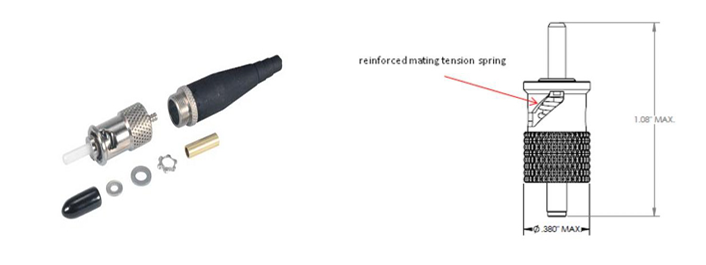
Products now exist to address the needs of a military network design. Specialized military connectors such as the Straight Tip (ST) are offered with extra heavy tension springs to assure physical mating will not be compromised in the event of a major shock or vibration. Other variations of the fiber ST connector are available that feature a locking mechanism which prevents optical disconnects in high shock or vibration environments.
Reinforced Military style ST fiber connectors
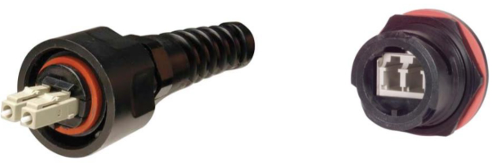
Other militarized fiber optic connectors include Ingress Protection (IP) rated designs that feature extra robust strain reliefs and screw lock mating for solid optical connections even when subjected to shock and vibration. Typical strain relief on these connectors is well over 250 Newton’s (56 lbs), which is over 50% better than standard, commercial fiber connector strain relief designs. This added protection ensures the cable assembly will survive incidental contact during the course of field use.
Military/Industrial IP66/67 Plug and Jack
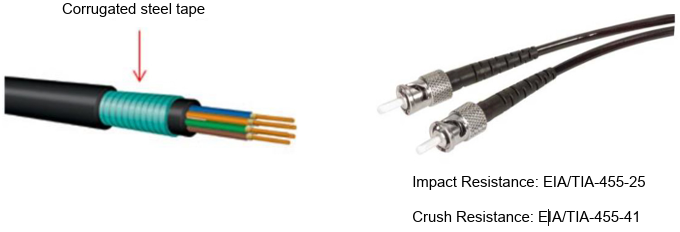
Fiber cable is now also offered in military/industrial styles featuring armored (typically corrugated steel) fiber cable as well as special crush and impact resistant simplex and duplex fiber patch cable designs.
Military style fiber cable options
Copper Ethernet Cabling: Category 5e and 6
Sometimes fiber optic systems cannot be used in military communications systems due to legacy equipment or purely on purpose, by design for whatever reason. In this case category rated copper infrastructure products are required. vTraditional civilian/commercial installations often use the standard unshielded twisted pair (UTP) cabling system which is fine for the controlled environments where most times the cabling is installed and never touched again for years. In the world of military communications applications, UTP systems will not cut it. By coupling shielded twisted pair (STP) cabling and ruggedized military style connectors, most design requirements can be met.
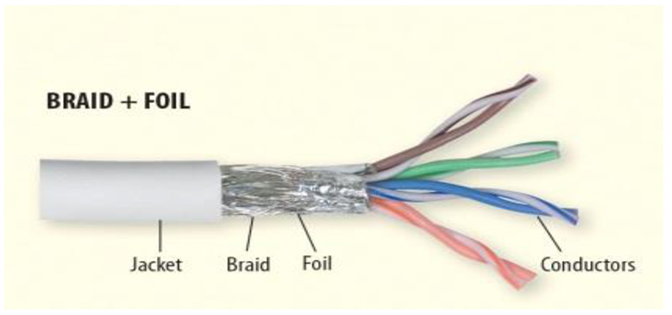
Shielded twisted pair cabling is used to lessen the effects of potentially data damaging EMI and RFI by either reflecting the EMI/RFI or by picking up the interference on the shielding and then conducting it to ground. In order for this shielding to work both shielded cable and shielded connectors must be used and the entire system must be properly grounded.
Example of double shielded (braid and foil) Category 5e cable
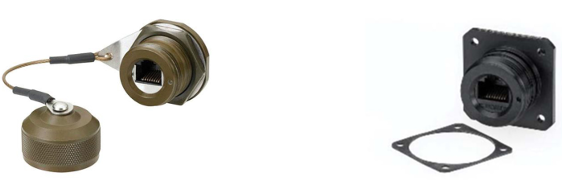
Many styles of military grade category rated connectors exist today including transversely sealed jack and plug options in Zinc Nickel which provides an excellent level of corrosion protection or Anodized finish that also increases corrosion resistance and wear resistance. These types of military connectors feature a compression nut that establishes the cable strain relief thus keeping the connection even when bumped or hit. Additionally, these types of connectors support 360° shielding when terminated to the cables shielding.
Zinc Nickel and Anodized Mil style RJ45 Plug and Jack
When Copper Is Necessary
Another consideration when designing cabling systems for military use is the cable jacket compounds. Typical UTP cabling often times utilizes Polyvinyl Chloride (PVC) material in the outer cable jacket. PVC is very toxic when burned and can act as a wick, increasing the spread of fire.
A very popular jacket type used in military cabling system is Low Smoke Zero Halogen (LSZH). LSZH cable produces very little smoke and no Halogens such as Fluorine, Chlorine, and Bromine which can cause harm to expensive communications equipment as well as endanger human lives. LSZH cables will self extinguish and are used extensively in shipboard, aerospace and mobile vehicle applications where confined space communications/ networking is prevalent.
Another popular cable jacket type is Polyurethane which stands up to damaging UV rays, is resistant to oils and petroleum-based products, and is very resistant to mechanical abuse where abrasions and cuts are commonplace. One downfall when using Polyurethane jacketed cables is that they give off very toxic gases when burned and do not self extinguish like LSZH cables.
Cable Jacket Materials
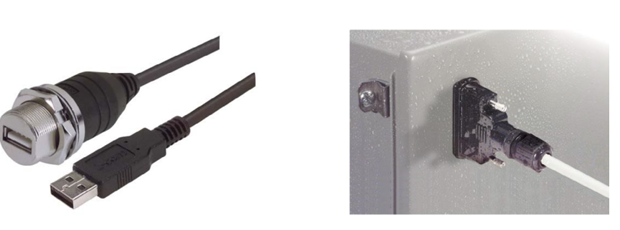
In addition to fiber optic and copper, RJ45 style interfaces, manufacturers are continuing to add other militarized/ rugged products to address military communications systems including USB, VGA, and D-Subminiature interfaces.
Ruggedized USB and D-subminiature Connectors
Recommendations
- Define requirements early: Before selecting a cable, document environment (temperature range, vibration/shock, chemical exposure, UV, EMI/RFI), expected flex cycles, installation constraints.
- Choose the right media:
- If EMI is severe or distance is long → consider fiber optic.
- If copper is used, ensure proper shielding, twisted pairs, and jacket material suited to the environment.
- Select appropriate jacket/insulation: For example, fluoropolymers, halogen-free compounds, abrasion/rodent protection, UV resistant outer diameter as needed.
- Budget for the premium: Accept that ruggedized cabling costs more but assess cost of downtime/failure in mission-critical systems.
- Collaboration is key: Work early with a vendor/manufacturer who understands military-grade cabling and can guide material, design and testing choices.
- Testing & verification: Once installed, perform verification under expected conditions (thermal cycling, vibration, EMI, etc.), monitor system performance, and plan for periodic inspection or replacement.
Why Military Applications Demand Specialized Cabling
Military and defense communication systems operate in environments that push cabling far beyond commercial limits. This white paper examines how fiber optic and copper Ethernet cabling are adapted for military use, including rugged construction, shielding strategies, jacket materials and compliance with military standards. It also explains why early cabling decisions matter in mission-critical systems, where failure carries far greater risk. This is a great resource for engineers and system designers who need cabling solutions that perform reliably under extreme environmental, mechanical and EMI conditions.
Conclusion
When designing a communications system for a military application several factors must be considered to address the harsh conditions often found in the field. Many commercial off the shelf (COTS) solutions exist today to achieve these design goals.
Frequently Asked Questions
A: Commercial cables are designed for “normal” environments (office, indoor, moderate temperatures). Military systems often face extremes of temperature, vibration, chemical exposure, and EMI.
A: As early as possible — ideally during the system definition or even concept phase. Because cable performance affects mechanical layout, installation routing, connectors, shielding, and overall system reliability.
A: Choose a vendor with experience in military/defense-grade cabling, who can support specification definition, materials selection, testing, and compliance with relevant standards.