
Power over Ethernet (PoE)
Download the Full Whitepaper (PDF)Executive Summary
Key Takeaways:
- PoE basics and benefits
- PoE enables data and power to be delivered over the same Ethernet cable, simplifying installations and reducing separate power wiring.
- It supports flexible device placement (e.g., IP cameras, wireless access points) even when standard AC outlets are unavailable.
- Standards evulution
- The original standard IEEE 802.3af (2003) allows up to ~15.4 W at source.
- Next, IEEE 802.3at (PoE+) extended to ~30 W.
- Then IEEE 802.3bt (sometimes PoE++) uses all four pairs to deliver up to ~60–90 W or more depending on cable and length.
- Cable length, temperature & bundle considerations
- PoE performance depends on cable length, conductor resistance, and bundle heat-rise; greater power means more heat and losses.
- Using higher-category cables and proper installation practices matters for higher power PoE.
- Mode of power injection and pair usage
- Power may be injected over spare pairs (in 10/100 Mb environments) or over data pairs (in gigabit environments) — so the wiring scheme matters.
- With 4-pair PoE, all pairs can contribute to power delivery, enabling higher power budgets.
- Safety, compatibility, and futureproofing
- PoE standards include negotiation and classification (to detect powered devices and safely deliver power).
- Planning for higher-power devices (LED lighting, thin clients, etc.) means choosing cabling and infrastructure that supports future PoE power classes.
Introduction
Power-over-Ethernet (PoE) is a technique that combines data and power onto a single Ethernet cable. The use of PoE compliant equipment eliminates the need to run 110/220 VAC power to remote network appliance devices in a wired LAN. In most cases the use of PoE can significantly decrease installation costs for remotely located devices. The use of PoE allows greater flexibility in the locating of network devices such as Wireless Access Points, Switches and IP Cameras.
Recommendations
- Select the right cable category: For higher power PoE (802.3bt and beyond), use Cat5e or better (Cat6/Cat6A) to reduce losses and accommodate heat rise.
- Limit cable length and bundling: Keep running within spec (max ~100 m for Ethernet) and avoid tightly bundled cables without derating heat.
- Plan for power budget: Calculate the total power demand of devices, losses in the cable, and margin for reliable operations (especially for 4-pair PoE).
- Use proper injection equipment: Ensure your power-sourcing equipment (PSE) supports the required standard/class and has detection/negotiation for powered devices (PDs).
- Manage thermal issues: Higher PoE portfolios mean more current in cables → increased temperature. Use proper ventilation, spacing, and cable selection.
- Label and document infrastructure: Especially in bundled or complex installs, mark which ports/devices are PoE, their class, power budget, and cable specs.
- Future-proof the design: Even if current devices demand modest power, installing higher-category cabling can save time and cost later.
A Brief History of PoE
The technique of combining data and power onto a single Ethernet cable has been around in one form or another since the early days of networking. The wireless community was one of the first to widely adopt this technique. In a replay of the video tape industry, many companies closely guarded the details of their “PoE” methods in the hope of garnering greater sales. As history has shown, a common standard will actually increase sales. The lack of a unified standard was hindering the growth of PoE capable equipment. Proprietary PoE equipment was costing customers more and in a bid to satisfy customer demands, major manufacturers called on the IEEE 802.3 Ethernet working group to develop a new standard which became 802.3af.
The 802.3af standard describes two types of devices, Power Sourcing Equipment (PSE) and Powered Devices (PD). The PSE provides the power to a PD. 802.3af compliant PSE also uses “smart” techniques so as to not supply power to non-PoE capable equipment thus possibly damaging them. Both the PSE and PD have power supplies and regulators isolated from ground to minimize any shock hazard or the introduction of ground loops that could impact data integrity.
Consumers in most cases, now have a common standard to rely on. They can now buy equipment from multiple vendors that will “in general” interconnect without issues. There is enough flexibility in the 802.3af standard however that there is a small possibility that equipment from different vendors may not work. For example power polarity is not specified. In some cases a simple configuration change of the PSE will solve the problem. In others the only option may be to use a PoE Mid-Span or Injector that is known to work with the PD or network appliance. Another issue is the large amount of legacy PoE equipment that will only operate with specific devices from the same vendor.
PoE Details and Variations
The 802.3af PoE standard allows two different methods, Mode A or B to combine data and power onto the same cable supplying power to the remote network appliance or PD. To comply with 802.3af, a PD such as a wireless AP, downstream switch or IP camera will work on both Mode A or B. An 802.3af compliant PSE such as a network switch will use Mode A only. Some legacy switches from major network equipment suppliers can work in 802.3af compliant Mode A or a proprietary form of Mode B.
A product called a MidSpan or Injector is used to upgrade a non-PoE Switch to have PSE capability. A MidSpan or Injector uses Mode B to power the PD. See Diagram 1.
Dia. 1
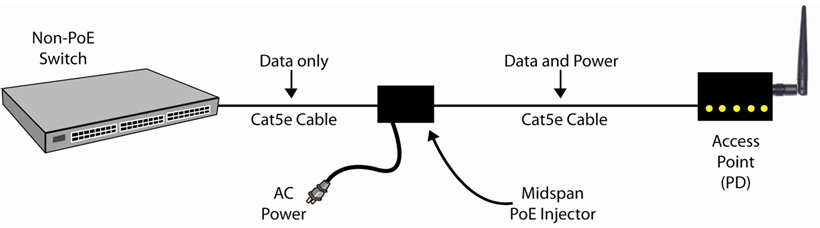
These devices can be fully compliant with 802.3af or be “Passive” and only offer power limiting. Passive MidSpans or Injectors offer lower cost as well as higher power capability and the ability to power non 802.3af compliant network appliances. In the wireless industry, to save cost or draw more power, it is common to use remote client devices that only work with passive PoE injectors.
Mode A
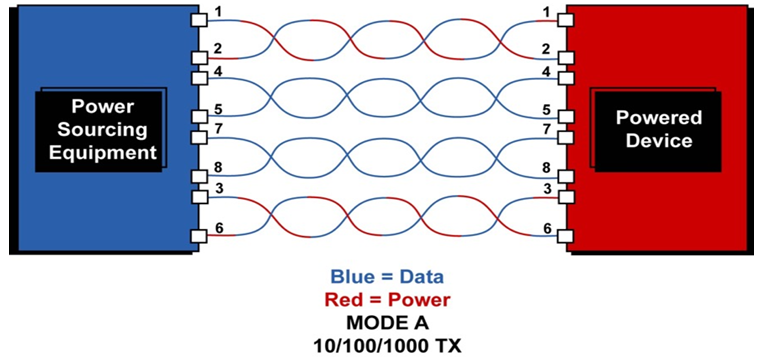
802.3af PoE Mode A combine’s power onto the same wires as the data signal using a technique called Phantom Powering. Phantom Powering is a common technique used in the Telco industry for Telephones and the audio industry for microphones.
For 10/100/1000BaseT, data pairs 1/2 and 3/6 carry DC power as well as data. Pairs 4/5 and 7/8 are used for data only. See diagram 2.
Dia. 2
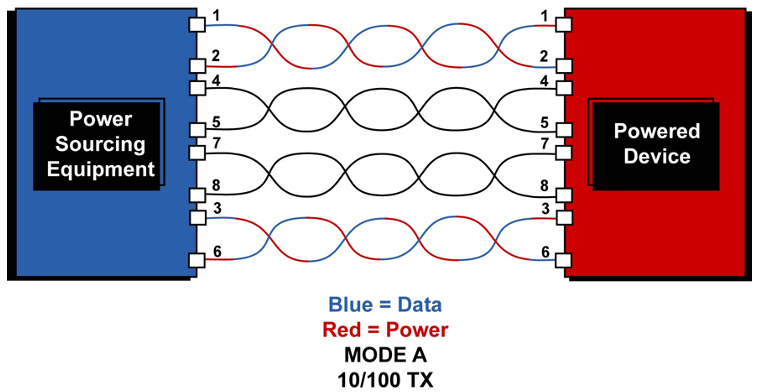
In the case of 10/100BaseT Mode A, spare pairs 4/5 and 7/8 are unused See Diagram 3.
Dia. 3
Mode B
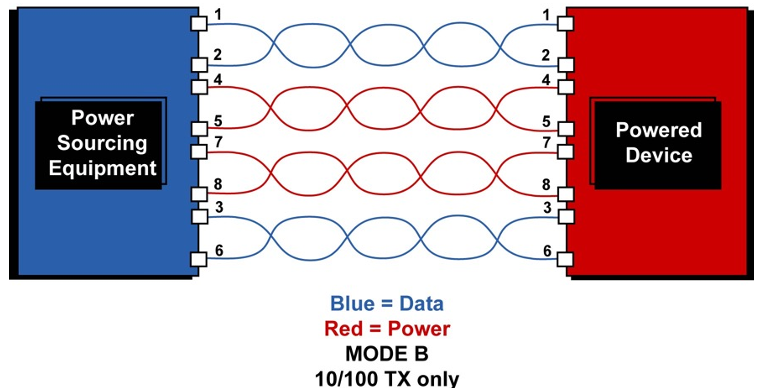
802.3af PoE Mode B uses the Ethernet spare pairs 4/5 and 7/8 to carry power. Pairs 1/2 and 3/6 are left untouched and carry data for 10/100BaseT. Mode B is unusable for 1000BaseT. See diagram 4.
Dia. 4
Design Considerations for Power over Ethernet Networks
Power over Ethernet (PoE) simplifies network design by delivering both data and power over a single Ethernet cable, but successful deployments depend on more than plugging devices into PoE ports. This white paper explains how PoE standards have evolved, how power is delivered over Ethernet, and how factors like cable selection, heat rise, bundling and power budgets affect performance and reliability. This is a great resource for engineers designing industrial or enterprise networks who want PoE deployments that work reliably today and continue to support higher-power devices over time.
Conclusion
PoE is perfect for remote locations where traditional AC power is not available. PoE is being used in many of today’s wired and wireless connectivity applications saving both time and money. Many communication devices are now being designed with PoE interfaces such as wireless Access Points, Ethernet Switches, IP phones and sensors used in industrial and process networks.
Frequently Asked Questions
A: Power over Ethernet (PoE) is a technology that delivers both electrical power and data over a single Ethernet cable. This eliminates the need for separate AC power wiring (110/220 VAC) to remote network devices, reducing installation complexity and cost.
A: PoE offers several advantages:
Reduces installation costs by eliminating separate power cabling
Enables flexible placement of network devices
Simplifies infrastructure in remote or hard-to-reach locations
Improves deployment speed for wireless access points, IP cameras, and switches
A: IEEE 802.3af is the standardized PoE specification developed by the IEEE 802.3 Ethernet working group. It ensures interoperability between devices from different manufacturers and defines how power is safely delivered over Ethernet cables.
A: The 802.3af standard defines two device types:
Power Sourcing Equipment (PSE): Supplies power over the Ethernet cable (e.g., PoE switches or injectors).
Powered Device (PD): Receives power from the PSE (e.g., wireless access points, IP cameras, IP phones).
A: 802.3af-compliant PSE devices use intelligent detection methods to identify whether a connected device supports PoE. Power is only delivered if a valid PoE-powered device (PD) is detected, preventing damage to non-PoE equipment.