
Industrial Wireless Mesh Network Architectures
Download the Full Whitepaper (PDF)Executive Summary
Key Takeaways:
- Wireless mesh networks provide self-healing and self-configuring connectivity, making them ideal for industrial environments.
- They eliminate single points of failure, improving network reliability and uptime.
- Mesh architecture enables scalable expansion without major changes to infrastructure.
- Ideal for harsh environments, including manufacturing plants, oil & gas facilities, and remote monitoring systems.
- Supports real-time data transmission, essential for Industrial IoT (IIoT) applications.
- Reduces wiring costs and simplifies deployment compared to traditional wired networks.
- Enhances coverage in complex layouts where wired or point-to-point wireless solutions fall short.
Introduction
Wireless communication eliminates the need for expensive cabling which has been traditionally used in commercial and industrial manufacturing and process networks. Today many small office, home office (SOHO) and enterprise networks employ wireless access either wholly or partially.
Commercial, Enterprise and SOHO networks differ from industrial networks in that a service interruption can be tolerated in most commercial networks but not in an industrial communications network. Many devices in an industrial network are communicating real time between themselves, controllers, or PLC’s. Should communication be lost to any of these devices a whole manufacturing line can stop or an entire batch in a processing network can be made unusable wasting both time and money.
In order for wireless networking to bridge over to industrial applications it must be self healing, have high device MTBF, have high levels of redundancy, provide real time access and control and be scalable to add new devices as the network grows. The next sections of this white paper highlight some of the more popular wireless industrial networking technologies being deployed today.
Mesh
A wireless mesh network provides both redundancy and self healing as each node in the mesh network is connected to at least one other node and uses intelligent routing to find other nodes in the network should its primary connection be disabled.
Mesh networks are ad-hoc networks in that nodes in the network forward data from other nodes. The determination of which nodes forward the data at a given time is made dynamically. This scheme provides link redundancy and ensures the data will reach its destination.
There are two basic types of mesh networks, partial mesh and full mesh. Partial mesh network nodes are only connected to certain nodes and not all the nodes in the mesh. In a full mesh network every node is connected to all the other nodes making a 100% mesh topology. Your specific application will determine whether a partial or full mesh network is required. See figure 1.
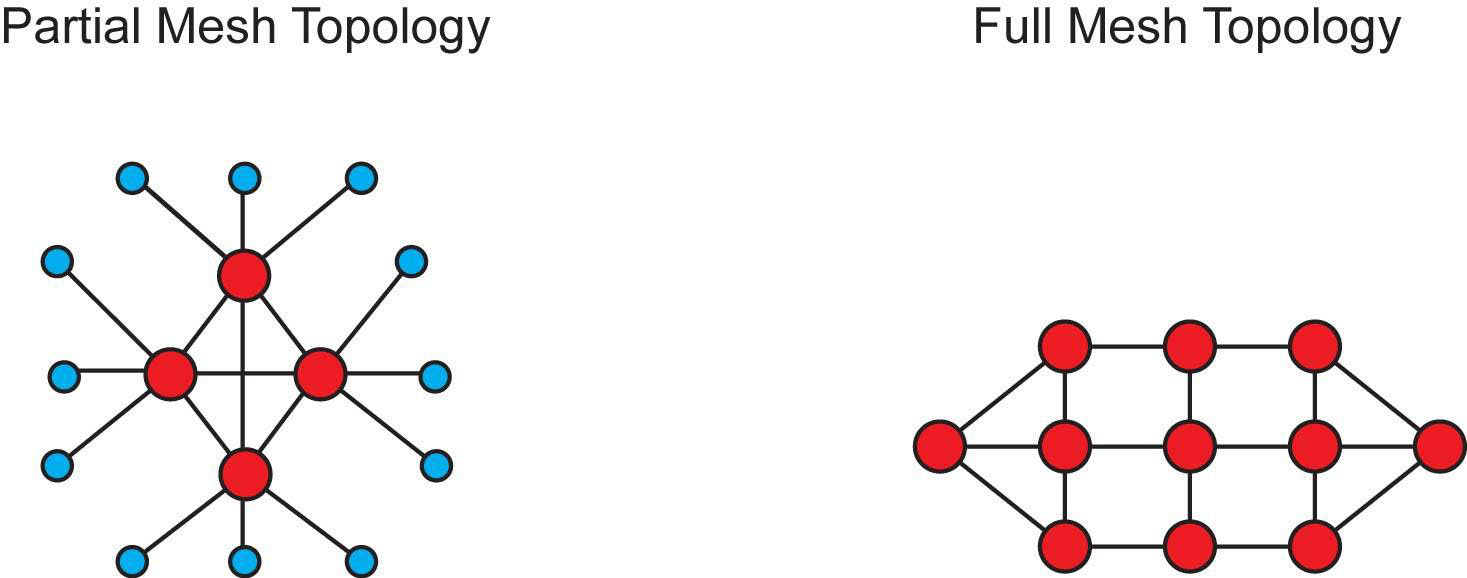
Fig. 1
Many mesh networking products available today utilize IEEE 802.11a/b/g/n protocols in the 2.4 GHz and 5 GHz frequency bands. These mesh devices can utilize both proprietary and standards based dynamic routing protocols such as Open Shortest Path First (OSPF). The IEEE is currently working on 802.11s which is a draft 802.11 amendment for mesh networking.
Recommendations
For industrial environments seeking reliable and scalable connectivity, wireless mesh networks are a strong choice. Businesses should:
- Evaluate environmental conditions and interference levels
- Choose industrial-grade networking equipment
- Plan node placement carefully for optimal coverage
- Implement robust security protocols
- Conduct testing before full-scale deployment
Partnering with experienced providers ensures smoother deployment and long-term network performance.
ZigBee
ZigBee wireless networks are based on the IEEE 802.15.4 standard for wireless personal area networks (WPAN). First developed for home automation, ZigBee networks are now being used in building automation, process control, and industrial automation. ZigBee chips can be found on temperature, moisture, and vibration sensors, switches and controllers.
Characteristics of ZigBee devices include relatively low power consumption (sleep mode is enabled when the device is not in use), relatively short-range communication, self-healing and redundancy capabilities, small data packet transfer (max 128 Bytes), and low cost. ZigBee networks utilize a mesh routing scheme where each ZigBee router relays data to adjoining routers in the network. This decentralized control provides great levels of redundancy. Should a device fail, the ZigBee router will find an alternative route to relay data keeping the network up. ZigBee networks are very scalable and support a network of up to 64,000 devices.
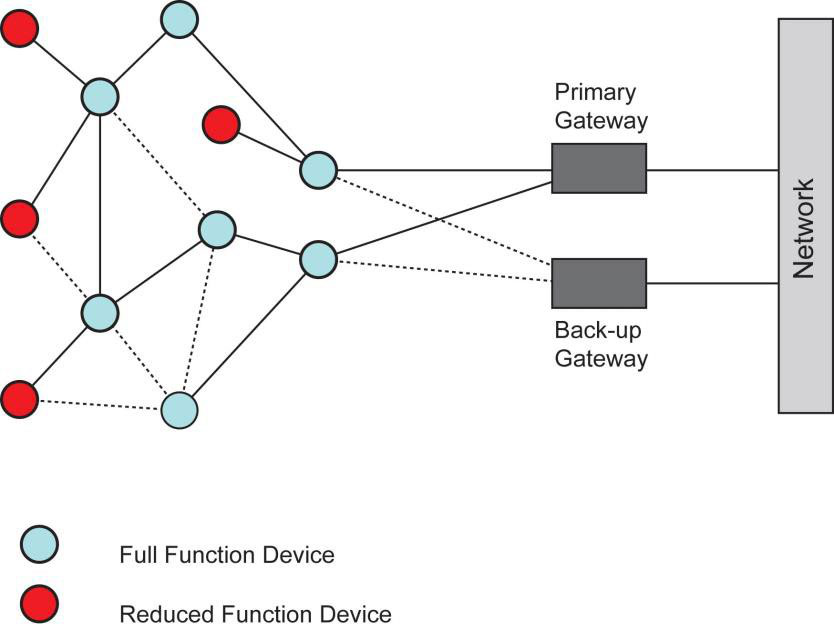
There are two classes of devices in a ZigBee network, a Full Function Device (FFD) and a Reduced Function Device (RFD). A FFD can function in any network topology (star, mesh, cluster, peer to peer) and can communicate to any other device in the network. A ZigBee coordinator and router are FFD’s. The RFD can only be used in a star topology and talks only to the network coordinator (see figure 2). A ZigBee wireless network requires at least one full function device to act as a network coordinator, but endpoint devices may be RFD’s (which typically cost less than FFD’s).
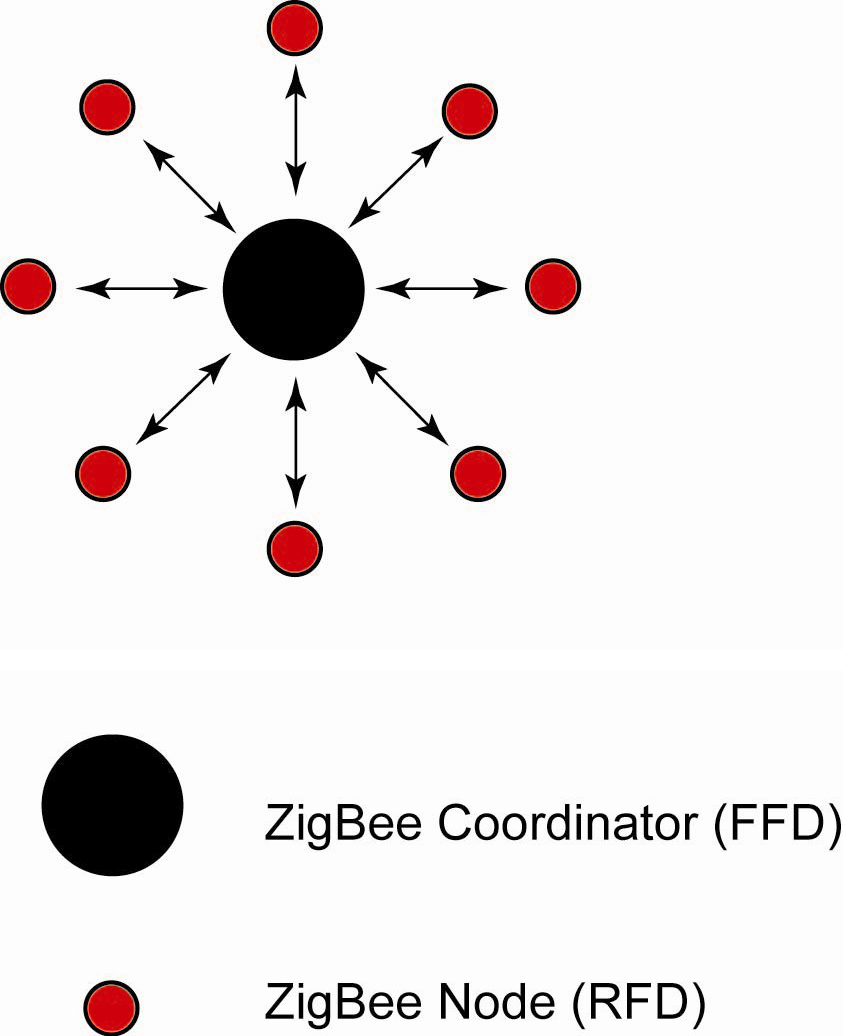
Fig. 2 ZigBee Star Network Topology
A ZigBee network is made up of network coordinator, network router, and the network nodes. The network coordinator sets up the network, manages the network nodes, stores network node information, and routes messages between nodes. The ZigBee router provides data routing between the other routers and the coordinator. The nodes are the end points of the ZigBee network, these are devices such as sensors, actuators, meters, and controllers. See figure 3.
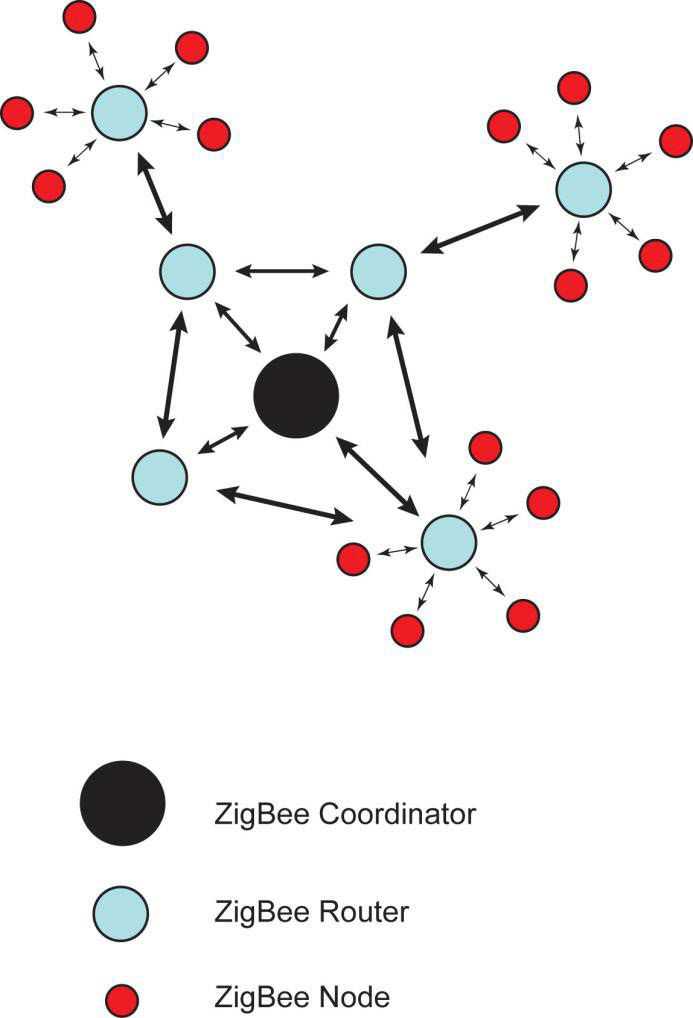
Fig. 3 ZigBee Cluster Network Architecture
WirelessHART
Developed by the HART Communication Foundation, WirelessHART is an open standard wireless networking technology. Like ZigBee, WirelessHART is a self-organizing, self-healing mesh network that offers high levels of redundancy and availability. WirelessHART was initially developed for the process industry as an alternative or add-on to existing wired HART technologies. Again, by using wireless technology the time and expense of designing, installing and maintaining a cable plant are avoided.
A WirelessHART network consists of WirelessHART field devices, at least one WirelessHART gateway, and a WirelessHART network manager. These components are connected into a wireless mesh network supporting bi-directional communication from HART host to field device and back.
The network manager manages the network devices and the mesh architecture. There is one network manager per WirelessHART mesh network. As the network manager is an application it can reside on any device on the network such as a gateway. The network manager forms the redundant mesh, monitors the network, and allows new devices to join the network. A gateway device can be used to connect the WirelessHART mesh network to a plant network (mostly wired networks), allowing data communications between the two. The field device or end node is the actual sensor, meter, valve etc. that is wirelessly connected to the network and sends and receives data.
WirelessHART supports several different network topologies including mesh, star, and hybrid (mesh/star) see figure 4.
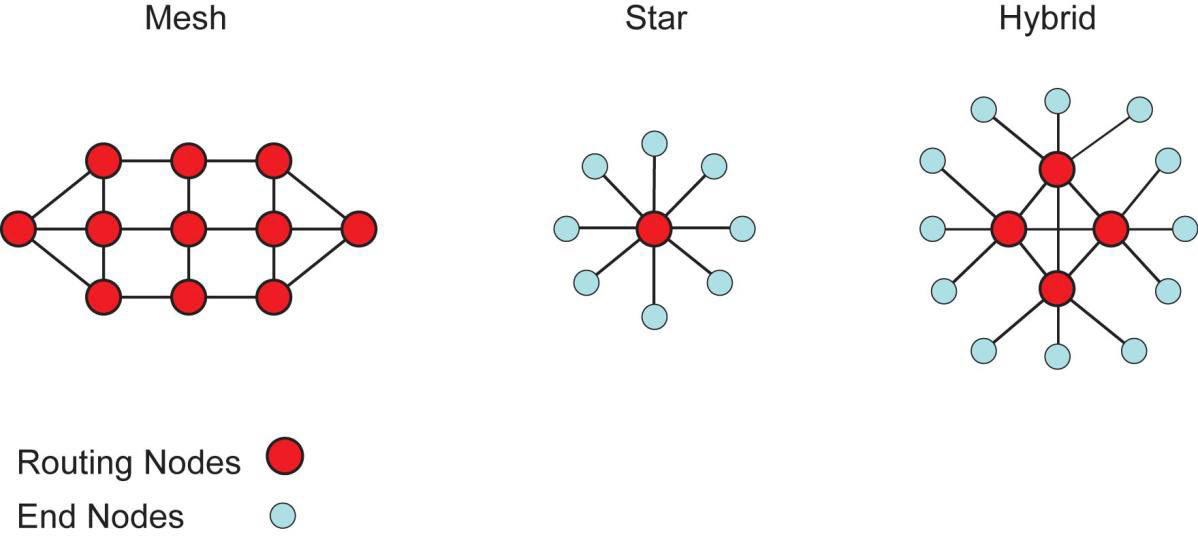
Fig. 4
Currently WirelessHART products operate in the 2.4 GHz ISM frequency band and like ZigBee is based on the IEEE 802.15.4 WPAN standard.
SP100.11a
The International Society of Automation (ISA) a non-profit organization dedicated to helping automation professionals solve difficult technical problems developed SP100.11a to support multiple protocols (HART, Modbus, Foundation Fieldbus, ProfiBus) via a single wireless network and to be used for both process and industrial automation/factory applications.
SP100.11a is based on 802.15.4 WPAN technology and utilizes the same self healing, self organizing mesh architecture as ZigBee and WirelessHART. Additionally, like ZigBee, SP100.11a devices will offer low power consumption and scalability to address network growth requirements. The difference between SP100.11a and ZigBee and WirelessHART is that SP100.11a works with many different protocols. This functionality allows SP100.11a to be implemented into existing networks that use disparate protocols to communicate.
SP100.11a was developed to address both process and factory automation networks where the networking of simple data acquisition applications such as monitoring, logging and alerting as well as more complex process control applications are addressed. The current implementation of SP100.11a uses 2.4 GHz 802.15.4-2006 radios and a single application layer for native and tunneling of other protocols. SP100.11a was ratified in June of 2009.
Read About Industrial Wireless Mesh Networks
Wireless industrial mesh networks offer a flexible, resilient, and scalable solution for modern industrial connectivity challenges. By enabling self-healing communication and reducing dependency on wired infrastructure, they support the growing demands of IIoT and smart industrial systems. Their ability to maintain uptime in harsh and complex environments makes them a preferred choice for forward-thinking industries.
Conclusion
Deploying a wireless mesh network for process and automation networks can save time and money as there is no need to hardwire devices together. New developments offer redundancy, security and scalability which are crucial to process and factory automation networks. Choosing the right technology/architecture depends on your specific application and environment. The different mesh architectures covered in this paper all have similarities which make them excellent candidates for use in industrial networks: redundancy, self healing capabilities, scalability, low power consumption and high MTBF.
References
1. http://www.hartcomm2.org/hart_protocol/wireless_hart/frames/architecture.html
Frequently Asked Questions
A: A wireless industrial mesh network is a decentralized network where each node connects to multiple other nodes, creating multiple pathways for data transmission. This ensures continuous connectivity even if one node fails.
A: Mesh networks use redundant communication paths, so if one connection is disrupted, data is automatically rerouted through another path, ensuring minimal downtime.